Rooted in a Restless Age
Richard Kannwischer
6 min read ⭑
We live in an age of accelerated outrage.
Scroll the headlines and you’ll see it everywhere: tempers flaring at school board meetings, road rage exploding on highways, viral videos of passengers losing it on planes, and political debates that feel more like cage matches than conversations. You see it in workplaces, on social media, even in churches. People interrupt, accuse, attack, withdraw. And more and more, we’re starting to expect it.
We brace for defensiveness. We assume bad intentions. We roll our eyes, shake our heads, and whisper things like, “It is what it is.” Impatience has become a badge of pride. Kindness is dismissed as weakness. Self-control feels optional. And love — the real kind, the steady, sacrificial, enemy-embracing kind — can feel like a fairy tale from another time.
In a world like this, it’s easy to become cynical. It’s easy to assume this is just how life works. But something deep inside us knows better. We long for a different way of being. Not just behavior tweaks, but real renovation.
Is there another way to live?
The apostle Paul believed there was, and not just a better strategy, but a better source.
He wrote a letter to a group of early Christians in a place called Galatia, a region where spiritual confusion and cultural pressure were pulling people in opposite directions. Some were trying to earn their worth by strict religious rule-keeping. Others were chasing a freedom with no center or guardrails. One group was motivated by fear, the other by appetite. But the result was the same: frustration, division and soul-level exhaustion.
Paul called it life “in the flesh.” And he knew it well. He had lived it, both as a religious zealot and a man shaped by power and performance.
But Paul had been transformed. And in his letter to the Galatians, he paints a vivid contrast between two ways of being: the self-guided life and the Spirit-led life. One produces competition, chaos, and control. The other cultivates something much deeper: a life that reflects the character of Christ.
And to describe that life, Paul doesn’t reach for a list of rules or accomplishments. He reaches for a garden.
Before Paul sketches a radiant orchard, he issues a sober warning. In Galatians 5:13-21, he opens the gate to a different field, the one we drift into when no one is watching the soil.
Picture an abandoned garden. No malicious act was required to ruin it; all it took was neglect. Weeds sprout first — small jealousies, whispered comparisons. Soon, thistles of anger crowd out tenderness, their barbs catching every passerby. Bitterness spreads like bindweed, wrapping tight around joy until sunlight can’t get in. Leave it longer and rot sets in: unchecked appetites, fractured friendships, distorted selves.
Paul names the fruit of that neglect in blunt strokes — sexual misconduct, manipulative spirituality, rivalry that turns conversations into cage fights, nights that blur into hangovers, a life ruled by impulse instead of love.
It’s a vivid reminder: If the Spirit isn’t sowing, the flesh is.
That’s why self-improvement alone can’t save us. We need the right gardener. We need a different seed. And that is exactly what Paul describes next: “But the fruit of the Spirit is love, joy, peace, [patience], kindness, goodness, faithfulness, gentleness and self-control" (Galatians 5:22,23).
Paul gives us a kind of pattern for how cultivation works. After describing the fruit of the Spirit, he writes, “Those who belong to Christ Jesus have crucified the flesh with its passions and desires. Since we live by the Spirit, let us keep in step with the Spirit.” (Galatians 5:24,25, emphasis mine).
There’s a sacred rhythm to this life — three movements that begin to shape us into people who bear fruit that lasts:
Movement #1: Belong to Christ
It all begins not with guilt, but with a gift. That’s where the roots go deepest.
There’s a moment in Toy Story 2 that captures this perfectly. Woody, the cowboy doll, gets stolen by a toy collector who wants to sell him to a museum. Woody is cleaned up, polished and restored, but something’s missing. Over time, Woody begins to forget who he really is. Then one day, he sees an old TV commercial where a boy embraces a toy just like him and it clicks. He rubs off the fresh paint on the bottom of his boot and sees the name “Andy” scrawled in ink. That’s all it takes. Woody now remembers where he belongs.
We forget too. Somewhere along the way, we stop hearing the voice of the One who made us. But you haven’t been forgotten, and you haven’t been left to figure this out alone. The One who formed you still cares what and who you become.
And maybe that’s the most important thing for you to remember right now: You belong to Jesus Christ. His name is already written on you.
“You were made to flourish ... And the journey starts now, with one faithful, Spirit-led step in love.”
Movement #2: Crucify Destructive Desires
Of course, growth also means letting go. And this is where it gets painful.
Most of us are a little too comfortable with our brokenness. We don’t love it, but we’ve made peace with it. We try to manage our sin rather than kill it. But the goal of cultivation isn’t maintenance; it’s transformation.
C.S. Lewis offers a searing image of this in The Great Divorce. A man journeys from hell toward heaven with a small red lizard on his shoulder. The lizard is constantly whispering poisonous lies in his ear. An angel approaches and offers to silence the creature and free the man from its influence, which the man thinks he wants.
“Then I will kill it,” the angel says.
“Oh — look out! You’re burning me,” the man protests. “Keep away.”
“Don’t you want him killed?”
“You didn’t say anything about killing him...”
Excuse after excuse, the man backpedals from the freedom he claims to want.
Lewis’s point is devastatingly clear: Sometimes we prefer the hell we know to the heaven we don’t. We can become disturbingly comfortable with our own dysfunction and destruction.
Is there a habit, desire or addiction you’ve been hiding or harboring? Something you’ve just learned to live with? You don’t have to keep feeding what’s devastating you. You can surrender it. Right now. The Spirit of the living God is ready to help — not just to silence the lies, but to set you free.
Movement #3: Keep in Step with the Spirit
Now for a lighter confession. During my sophomore year of college in San Antonio, I needed a P.E. credit. I had played a lot of sports growing up, but I wanted to try something new. So, when a pretty girl invited me to take Couples Country & Western Dancing with her and some friends, I signed up.
One afternoon, someone on the varsity dance team (the “Ropers”) got sick. They needed a fill-in or the whole routine would be scrapped. I had seen the routine once or twice, but I’d never danced it. I was nowhere near ready.
Then Amy, one of the best dancers in the group, turned to me and said, “Come on, Rich. Trust me. Just follow me. I know the routine. All you’ve got to do is keep in step. No matter what, 1-2-3, 2-2-3. You can do it.” (That’s a waltz, by the way).
I was terrified. I had no idea what I was doing except for the basics. But I followed, and while it wasn’t perfect, it was still beautiful.
Not because I was impressive, but because of the one I was dancing with.
You may feel like I did that day, like you’re faking it, stumbling through, unsure how to move forward. But if you’ll keep in step with the Spirit — even if you don’t fully know the routine — it can still be beautiful.
That's what this journey is about: learning to listen for the rhythm of God’s Spirit, following his lead and allowing the fruit of his presence to grow over time.
You were made for more than image management. You were made to walk with God.
And that walk begins here, with one step. One step away from the self-absorption of the age. One step away from the performance trap. One step away from self-improvement projects and toward spiritual surrender. One step away from the thorns of anger, envy and impulse, and into the soil of grace and renewal.
Trying harder alone won’t get you to where you are called to be. You can’t manufacture fruit. You don’t need to fix yourself before God begins his work. That’s the beauty of the gospel: God is already tending the soil. He is already planting the seeds.
All you’re asked to do is stay rooted. Stay available and keep in step.
The Spirit is already at work — quietly, faithfully — shaping you into the kind of person who bears life for the world.
You were made to flourish, to bear this kind of fruit. And the journey starts now, with one faithful, Spirit-led step in love.

Richard Kannwischer is the pastor of Peachtree Church in Atlanta, Georgia. For more than 25 years, he’s been recognized as a gifted communicator whose greatest passion is helping people understand how the story of God speaks with clarity, depth and relevance to their everyday lives.
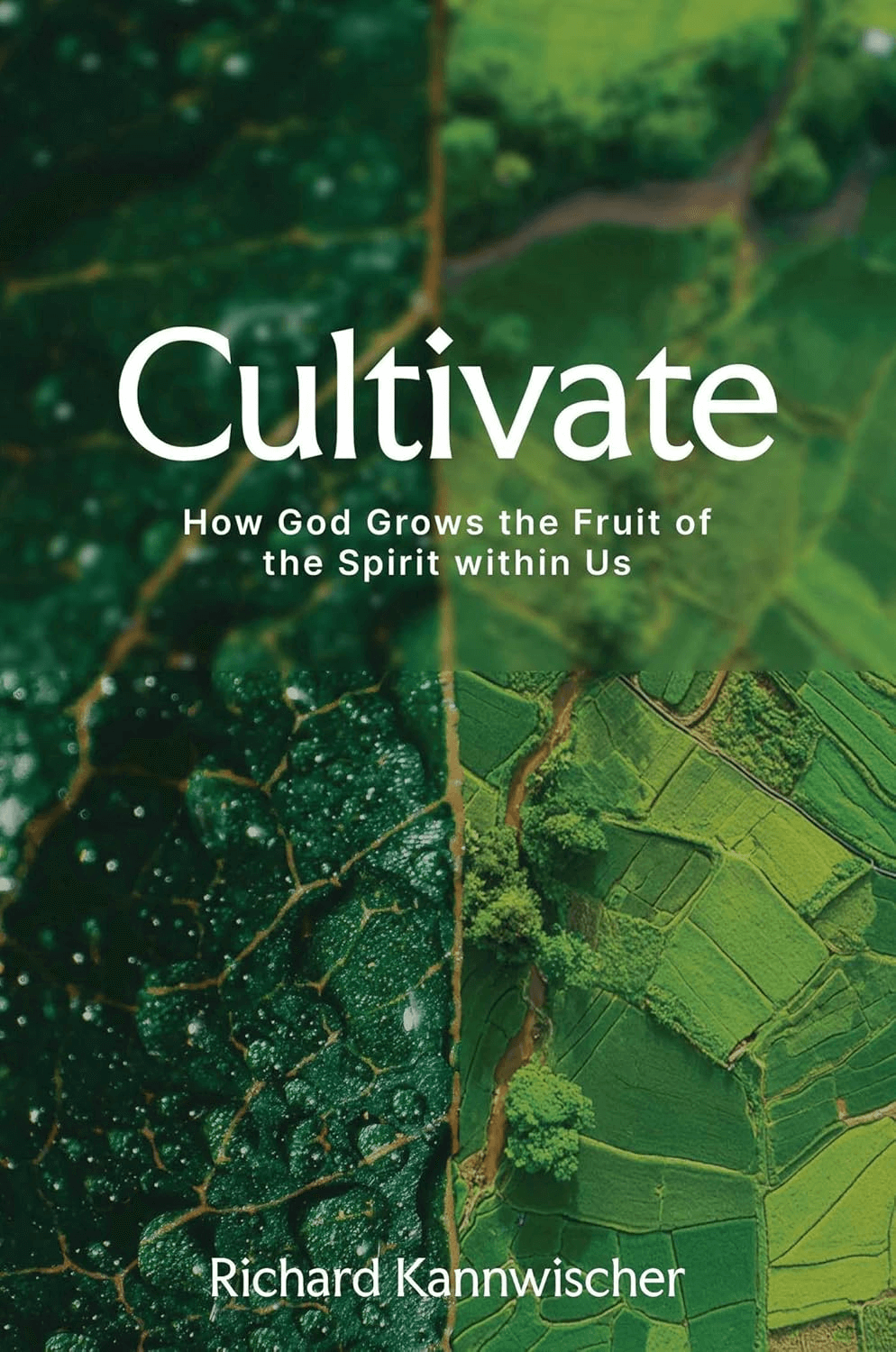
Adapted from “Cultivate” by Richard Kannwischer. Copyright © 2025. Used with permission of the author.